

A new important stage in the implementation of the ‘Harmony Link’ project
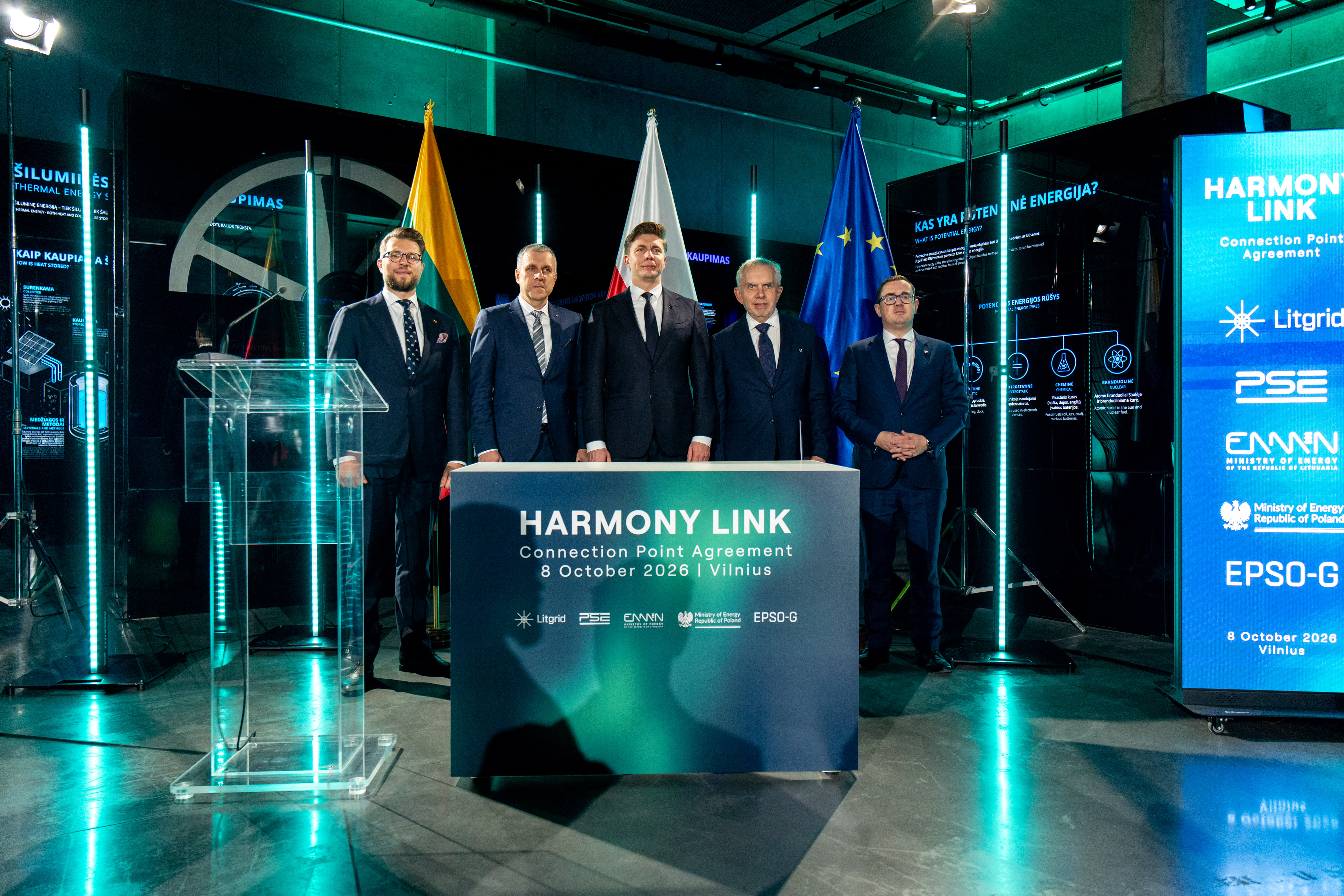
Litgrid, the Lithuanian electricity transmission system operator, and Polskie Sieci Elektroenergetyczne (PSE), the Polish electricity transmission system operator, have signed a connection point agreement regarding the construction of the 220 kV Harmony Link electricity interconnector between Lithuania and Poland. The connection point agreement is one of the key documents for the Harmony Link project; through it, Litgrid and PSE have solidified their joint commitment to implementing the project and constructing the transmission line connecting the Lithuanian and Polish electricity grids, while also establishing clear rules for testing and connecting the line at the border interconnection point. The energy ministers of Poland and Lithuania have signed a joint statement.
“Harmony Link is more than just an electricity interconnector between two close neighbours and strategic partners. This project, which has today reached another important milestone, is helping to build an even more secure, resilient and reliable energy system. It is infrastructure that brings Lithuania closer to its ambitious goal of becoming an electricity-exporting country. So we are not only building an electricity interconnector, we are creating a gateway for Lithuanian energy to Europe,” says Prime Minister Mindaugas Sinkevičius.
“We must strengthen the energy transition every day through concrete actions. Harmony Link will provide greater opportunities for electricity trade with Poland and allow for the more efficient use of the growing renewable electricity generation in Lithuania. For residents and businesses, this will mean a more reliable electricity supply and better conditions for competitive prices. This agreement enshrines the joint responsibility of Lithuania and Poland to implement the interconnector. Therefore, the priority now is to ensure that the planned work proceeds on schedule,” said Minister of Energy of the Republic of Lithuania Lukas Savickas.
“We are strengthening the region’s energy security through tangible investments and close cooperation. Harmony Link is an excellent example of this. It brings together the capabilities of Poland and Lithuania, increases opportunities for electricity exchange, and enhances the security of the Baltic countries’ power systems. Poland’s strength also lies in our partnerships across the region. That is why we continue to develop infrastructure that provides greater operational flexibility, enables mutual support, and improves our ability to respond to threats. The agreement signed today marks another step forward in the implementation of a strategic investment that will strengthen the energy system of the entire region,” said Minister of Energy of the Republic of Poland, Miłosz Motyka.
“This agreement is the result of months of collaborative work between the Lithuanian and Polish system operators. I am pleased that we now have a clear agreement, vital to both sides, that allows us to move forward confidently with the implementation of Harmony Link. Soon, this interconnector will strengthen the ties between the electricity systems of the Baltic States and Poland, enhance security of supply, and create greater opportunities for electricity trading in the region,” said Andrius Šemeškevičius, CEO of Litgrid.
“The Harmony Link interconnector will be of strategic importance for the security of electricity systems and the functioning of the market in our European region. Security aspects are a priority in the implementation of this project,” said Grzegorz Onichimowski, PSE President.
During the ceremony, Minister of Energy Lukas Savickas and Polish Minister of Energy Miłosz Motyka signed a joint statement on strengthening energy infrastructure security and mutual assistance, reaffirming the countries’ commitment to bringing the Harmony Link interconnector online by December 31, 2030.
The ministers agreed to develop rapid cross-border assistance mechanisms for disruptions to critical energy infrastructure, conduct joint exercises, strengthen physical and cyber security, and stockpile critical equipment. There is also a call for targeted EU funding to be made available not only for cross-border projects but also for enhancing the resilience of domestic grids.
Harmony Link will be constructed using a combination of overhead lines and cable sections. The interconnection point agreement defines the respective obligations and the division of responsibilities between PSE and Litgrid regarding the construction of the interconnector and fiber-optic communication lines. The agreement covers preparatory, design, construction, and installation work at the interconnection point. The document establishes a framework for cooperation between PSE, Litgrid, and their contractors, and defines the procedures and sequencing for the various project stages. Furthermore, it outlines technical requirements, including procedures for verifying equipment compatibility and conducting inspections and tests following the completion of construction work.
The physical interconnection point on the Polish-Lithuanian border will be located approximately 35 meters inside Polish territory. For operational reasons, PSE will acquire this section of the cable line from Litgrid. The agreement also sets out procedures for defect rectification during the warranty period. The Harmony Link onshore connection project in Lithuania is planned for the territories of the Vilkaviškis District, Kalvarija, and Marijampolė municipalities. It comprises the construction of a new double-circuit 220 kV alternating current (AC) electricity transmission line—running from the Ełk Bis substation via the Norki and Wigry substations in Poland to the Lithuanian border, and continuing to the planned Gižai substation in the Vilkaviškis District—as well as the refurbishment of the existing 220 kV Ostrołęka–Ełk Bis line in Poland.
Construction work on the Harmony Link connection in Lithuania is scheduled to begin in the second quarter of 2027. The connection is planned to be commissioned by the end of 2030.
The Harmony Link onshore connection project has been granted the status of a project of special state importance.
The Harmony Link project is co-financed by the European Union through the Connecting Europe Facility (CEF) with the aim of strengthening the country’s energy security, integrating more renewable energy sources, and ensuring capacity for commercial electricity trading following the synchronization of the Baltic states’ grids with those of Continental Europe.