

Dmitrij Golovanov and Jan Maksimovič invite us into a jazz meditation on Čiurlionis’s world: return brighter, lighter, and enriched
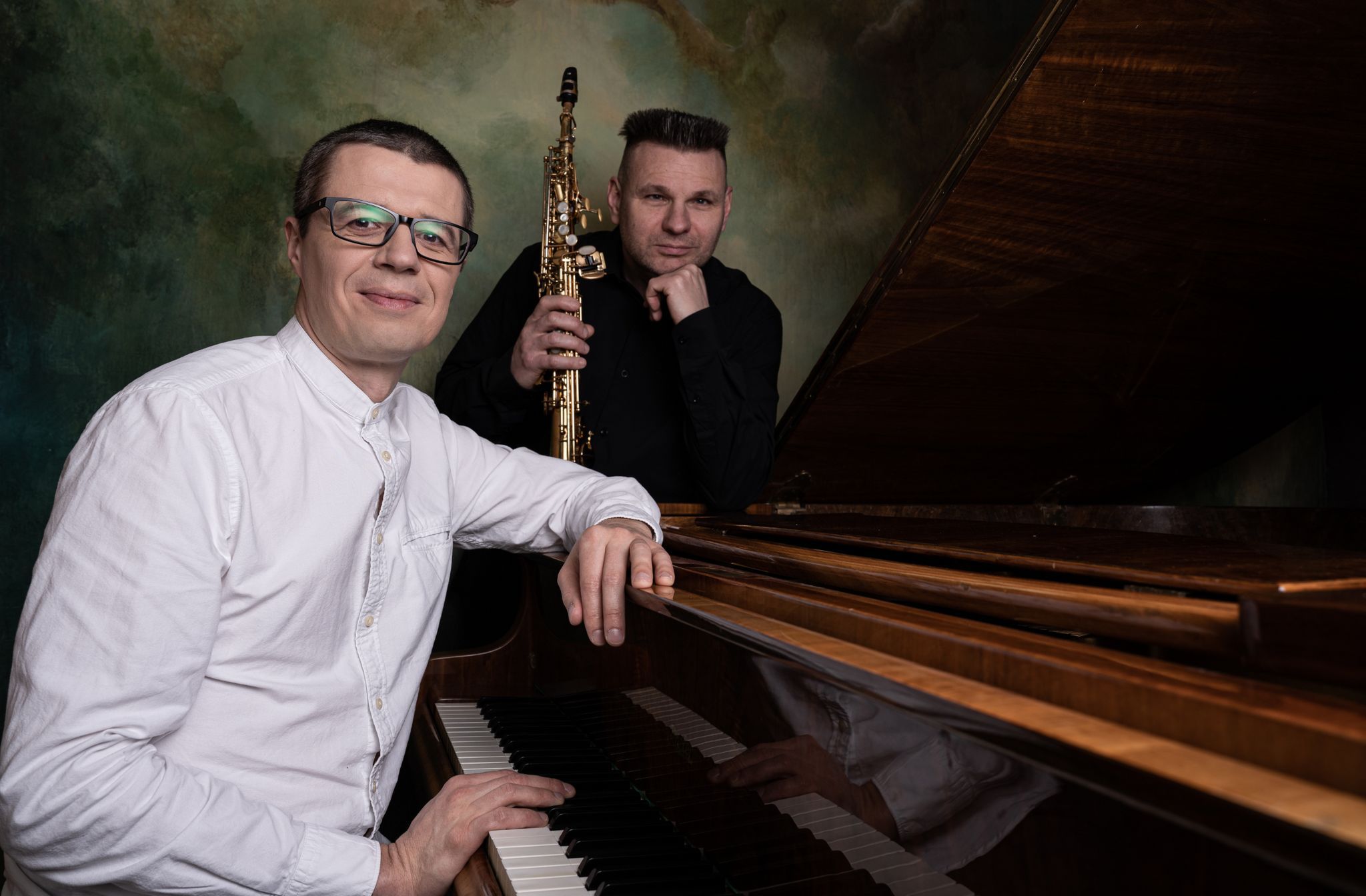
Today at 11:45 a.m., the Lithuanian Jazz Federation and the Lithuanian National Commission for UNESCO invite you to the traditional Jazz Brunch: Following Čiurlionis. To mark International Jazz Day, a one-of-a-kind, free open-air presentation of the project Following Čiurlionis will take place in the courtyard of the National M. K. Čiurlionis School of Art in Vilnius. The concert will feature pianist Dmitrij Golovanov and saxophonist Jan Maksimovič performing their own jazz arrangements of M. K. Čiurlionis’ piano preludes. We spoke with Dmitrij about how this Čiurlionis-inspired jazz duo came to being, what musical colours emerged in the process, and how Čiurlionis transforms the human spirit.
Some say Čiurlionis is strictly classical—there's no room for jazz there. And yet, you’ve found potential for jazz in his compositions. You’ve mentioned before that the project began seven years ago, when you started improvising on Čiurlionis’s unfinished sketches. Could you remind us how Following Čiurlionis began? How would you describe the divide—and connection—between classical music and jazz? How much of Čiurlionis and how much of jazz is in your programme?
Is there jazz in classical music—and classical music in jazz? Of course, these genres are quite different. But music as a whole shares many similarities: in form, harmony, melody, rhythm, and other means of expression.
When a professional musician knows the language of music, they can retell a classical piece in the language of jazz—and vice versa. It requires certain knowledge, skills, experience, taste, and imagination. But the real question is—why do it?
It all began when pianist Rokas Zubovas invited us to improvise on Čiurlionis’s unfinished compositions—or more precisely, on small pieces inspired by his musical sketches and ideas. That’s what improvisers do: we take small musical ideas and develop them into extended improvisations or completed works.
The idea was compelling. Čiurlionis was a visionary—his musical language was ahead of his time, modern in its own way, yet deeply rooted in Lithuanian folk music. That really resonated with us. We're always trying to look for a contemporary sound, a new direction, but our music still reflects our inner world, our roots, our values.
Over time, we realized that there was too much of us in our programme and not enough of his genius. But at the same time, as we immersed in his musical world, we felt the need to seek ourselves within the context of his preludes.
You’ve said that the deeper you delved into Čiurlionis’s music, the more he became your inspiration and teacher—that his music changed your perspective and your sound. Could you tell us more? How did he change you, and what personal transformations have you noticed?
At first, we were searching for new colours and inspiration. We hoped to modernize and re-contextualize Čiurlionis’s music. But as we played it, we realized we were the ones being taught. So we began refining and clarifying our approach, paring back our usual stylistic imprint, and instead developing Čiurlionis’s musical palette and language.
Naturally, as we followed in his footsteps, our own musical language began to evolve. As the saying goes, ‘You become like those you spend time with’ (smiles).
These changes required more attention, more nuance and subtlety in the music, and a shift in how we approached improvisation. Even in our own original concerts now, Jan and I incorporate discoveries inspired by Čiurlionis.
And yes—we’ve changed, too. We’ve become more mature, perhaps calmer and lighter, and I dare say we have become broader-minded.
Some people say that to understand classical music—or jazz—you need special knowledge and that it is difficult ‘to get’ jazz. But Čiurlionis seems so universal. Do you think jazzed Čiurlionis can reach beyond connoisseurs?
Absolutely. The language of music is universal. It holds keys to the human soul regardless of nationality, age, education, or musical experience. Our aim with this project is to create a cultural dialogue between classical and improvisational music. That’s why we invite jazz lovers to experience improvisation in a new context—rich in subtle musical ideas and fine textures. And we also invite fans of classical music and Čiurlionis to hear how his thoughts can be paraphrased and transformed.
What should listeners expect when they follow Čiurlionis with you? Jazz? Classical? Emotion? Reflection? Themselves?
This isn’t typical jazz. It’s more a revelation of our improvisational philosophy and worldview—through the language of Čiurlionis. We invite listeners who are open—those who are curious, who question, who explore—to follow Čiurlionis with us. Such a listener will surely discover the beauty and fragility of his music, and, like in meditation, reflect on both music within themselves and themselves within the music. Together, we’ll travel into Čiurlionis’s world and return brighter, lighter, and enriched.
Čiurlionis’s musical language feels so universal—surely it resonates abroad as well. Have you noticed how foreign audiences respond to it?
I’ve played Čiurlionis several times in Spain. Recently, Jan and I did it in Ukraine. We’re planning to bring the programme to Estonia and Latvia.
Like all music created by geniuses, Čiurlionis’s compositions know no geographic boundaries. I’m proud that Lithuania has such a national treasure—an artist whose music and paintings bring global recognition to our country.
As a musician, I’m most moved by how deeply and emotionally audiences respond to Čiurlionis’s music. In today’s world—full of hatred, falsehoods, and political turmoil—what endures is our humanity. We want and need to remain human. And it is art—boundless, borderless, non-political—that sensitively asks questions and invites dialogue about our need for beauty, emotion, and connection. That’s the kind of art that truly touches the soul—no matter where it’s performed.
In 2025, we are celebrating the 150th anniversary of Mikalojus Konstantinas Čiurlionis, a milestone recognised by UNESCO. The anniversary programme, curated by the Office of the Government, invites the world to explore Čiurlionis’s creative universe under the motto: Deeper than the eye can see. His works are not just what we see or hear on the surface—they are codes waiting to be explored by curious minds. More information about the Čiurlionis 150 programme is available at ciurlioniui150.lt.