

Lithuanian Prime Minister after meeting with Mark Rutte: Lithuania will continue to demonstrate leadership in NATO
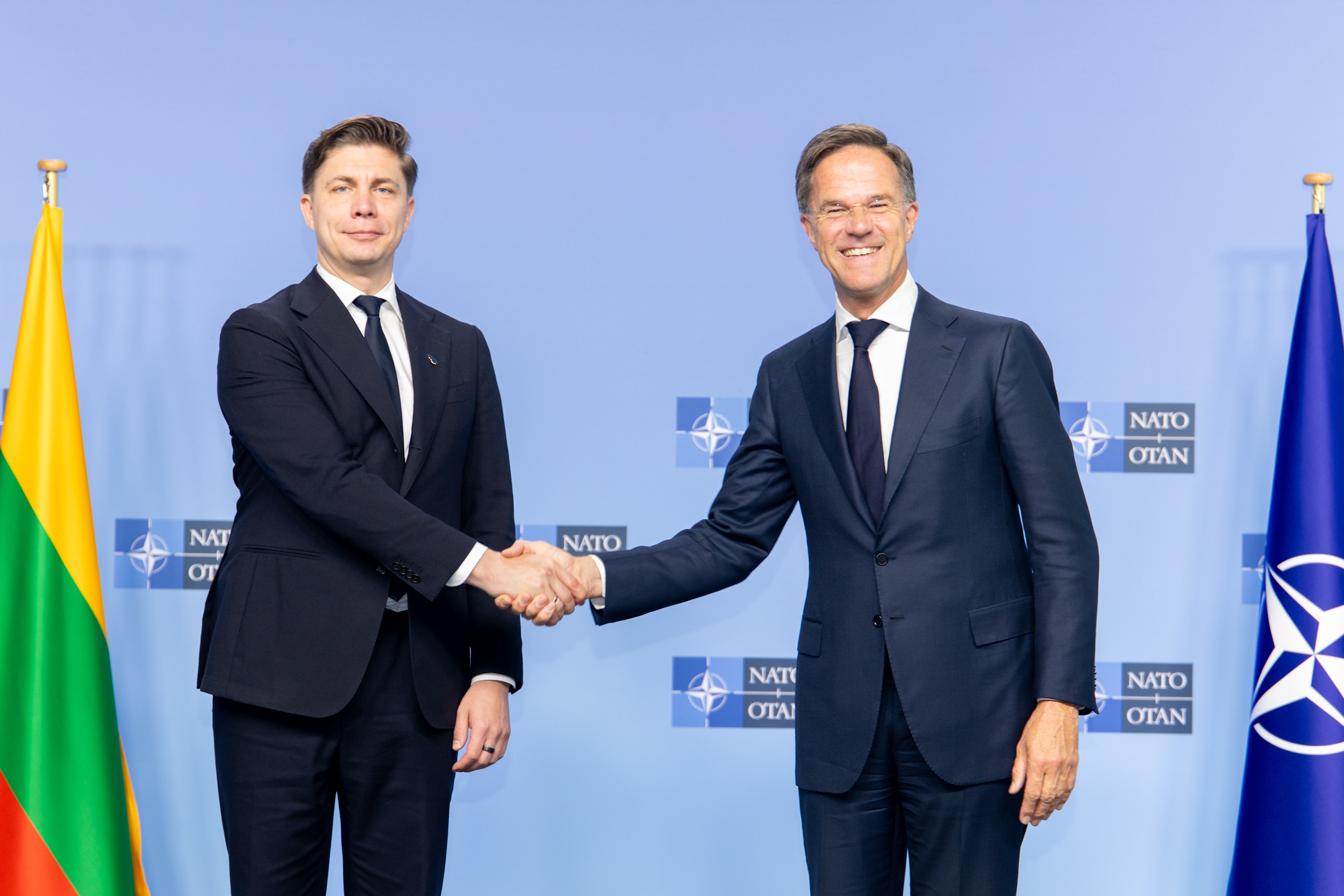
During a working visit to Brussels, Prime Minister Mindaugas Sinkevičius met with NATO Secretary General Mark Rutte to discuss the security of the Alliance’s eastern flank, strengthening of Lithuania’s defence, NATO’s response to growing hybrid threats, and other relevant issues.
The Prime Minister reaffirmed Lithuania’s commitment to remaining part of the so-called “5 percent club.” At the NATO Summit in The Hague, Allies agreed on a new defence spending target: 3.5% of GDP for core defence expenditure and an additional 1.5% for defence-related projects. Lithuania is currently allocating 5.38% of GDP to defence, while total spending on security and defence, including related investments, amounts to 6–7% of GDP. As NATO Secretary General Mark Rutte noted, it is not enough simply to say that Lithuania is meeting its commitments—Lithuania is setting a new standard for NATO.
“Our security is a common cause, and our response must therefore be collective. NATO unity is our greatest strategic advantage. The Alliance makes Lithuania safer, and Lithuania, in turn, strengthens the Alliance—not only through record levels of defence spending, but also by developing the concrete capabilities needed to ensure credible deterrence,” said Mindaugas Sinkevičius. The permanent deployment of the German brigade in Lithuania by 2027 remains one of the country’s key priorities, and the development of all necessary infrastructure is proceeding according to plan. The presence of US military forces in Lithuania was also discussed. Mindaugas Sinkevičius stressed that the long-term involvement of Germany and the United States is an essential part of credible deterrence on the eastern flank.
“Our goal is to have a fully operational national division, strong air and missile defence, and other capabilities necessary for NATO defence plans by 2030. However, security is a shared Alliance commitment, so it is essential that all Allies increase their core defence spending as early as possible,” said Mindaugas Sinkevičius.
The Prime Minister welcomed the decision to transition from air policing to an air defence mission in the Baltic states, as an important step in strengthening the capacity to respond rapidly to various types of threats and ensure the defence of the entire Alliance territory. Lithuania is seeking a greater NATO presence in the region in terms of air capabilities, airspace surveillance, and command-and-control assets, including AWACS.
According to Mindaugas Sinkevičius, Russia’s hybrid attacks must be viewed not as isolated incidents, but as deliberate and systematic activity directed against NATO.
The meeting also addressed the security situation in Belarus and the importance of NATO’s nuclear deterrence. The need to continue supporting Ukraine, which is being devastated by Russia’s war, was also emphasized, along with other regional security issues. The Prime Minister pointed out that Ukraine’s security is inseparable from the security of Europe and the entire transatlantic community; therefore, Lithuania remains committed to allocating at least 0.25% of GDP annually to military assistance.
Mindaugas Sinkevičius outlined Lithuania’s plans to complete the constitutional amendment process, removing the remaining restrictions on the country’s full participation in NATO’s collective defence and deterrence arrangements.
After the meeting, Mark Rutte and Mindaugas Sinkevičius offered their remarks for the press, which can be found on the official NATO website.
Last updated: 29-09-2026
Related news:
Prime Minister Congratulates Austria on Its National Day
Prime Minister Congratulates Hungary on the 70th Anniversary of the Revolution
Prime Minister Congratulates Romania’s New Head of Government
Prime Minister Speaks with Ukrainian President V. Zelenskyy
Lithuanian and Polish Leaders Discuss Joint Efforts to Strengthen Regional Security