

Prime Minister in Bucharest Stresses the Importance of Unity Among Allies for Ukraine's Victory
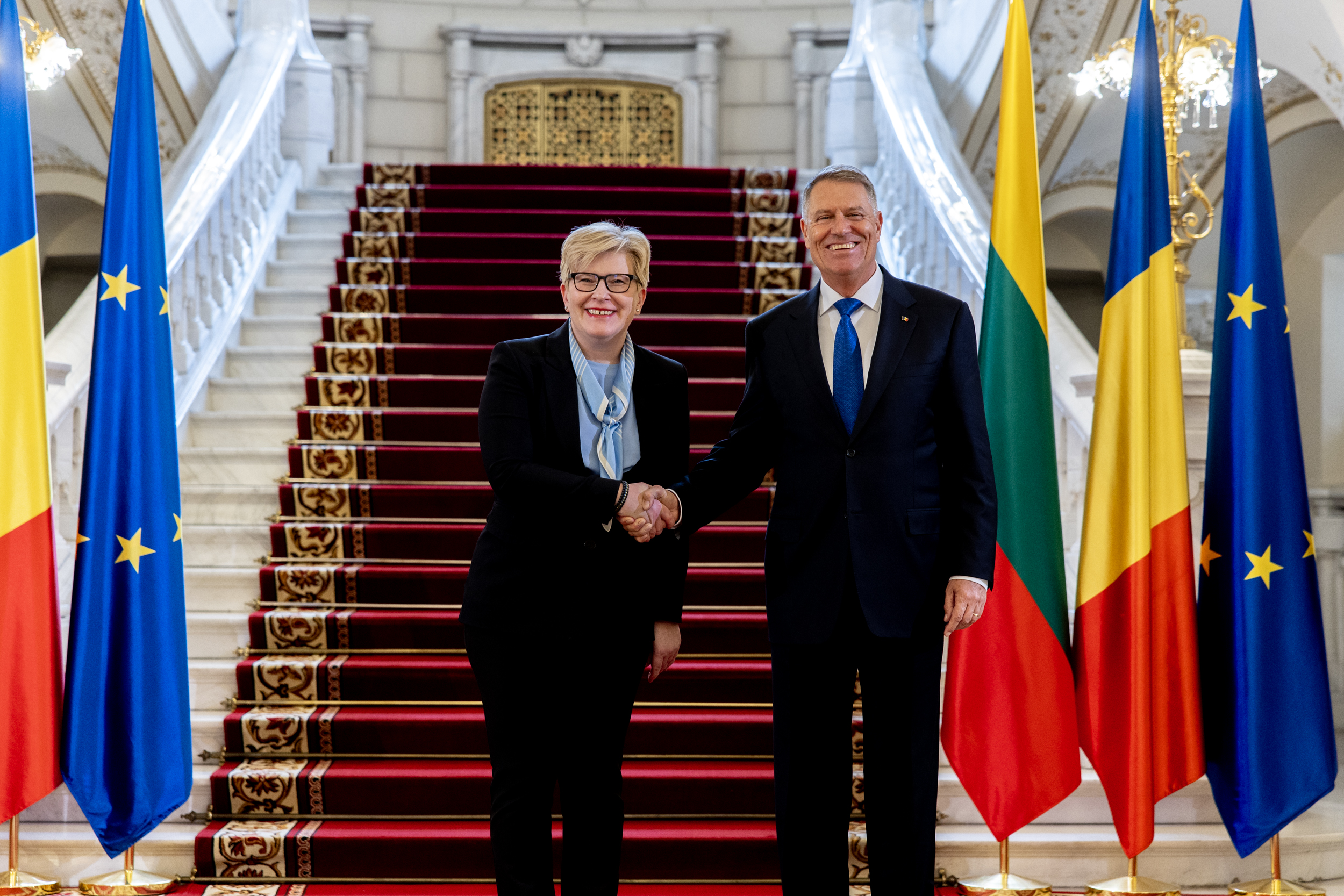
On the second day of her visit to Bucharest, Prime Minister Ingrida Šimonytė met with Romanian President Klaus Iohannis and Finnish Prime Minister Petteri Orpo to discuss the need to strengthen the unity of NATO and its allies and to mobilise more support for Ukraine.
Also on Wednesday, the Lithuanian Head of Government addressed the Congress of the European People's Party (EPP) and took part in a roundtable discussion at the Euro-Atlantic Centre for Resilience, which focused on the security situation in the Black Sea, as well as on other issues related to regional security and resilience building.
The meeting with the President of Romania, K. Iohannis, highlighted the common security interests of Lithuania and Romania - the victory of Ukraine, which is defending itself against Russian aggression, and cooperation in strengthening the security of NATO's eastern flank. The Lithuanian Prime Minister underlined the importance of unity and a strong posture of the entire transatlantic community in order to achieve Ukrainian victory and deter Russia.
As the meeting pointed out, if Russia is not stopped in Ukraine, no European country can feel completely safe.
In her meeting with Finnish Prime Minister Orpo, the Lithuanian Prime Minister stressed that as the Baltic Sea is becoming NATO's inner sea, the countries of the region need to tighten their coordination to strengthen the Alliance's eastern periphery and, by extension, NATO.
"Finland is a close partner and ally of Lithuania in every sense, with whom we share a common responsibility for the security of our region and a common challenge in helping Ukraine to confront and defeat Russian aggression," said the Prime Minister.
Lithuania highly appreciates not only the development of cooperation between Lithuania and Finland, but also the format of the North-Baltic Eight (NB8), especially with the accession of Finland to NATO, soon to be followed by Sweden.
Enhanced cooperation is also driven by the need to build resilience to hybrid threats, such as illegal and artificially induced migration, which Lithuania, Finland, and other countries in the region have faced in recent years.