

Prime Minister: memory teaches responsibility and recalls the value of freedom
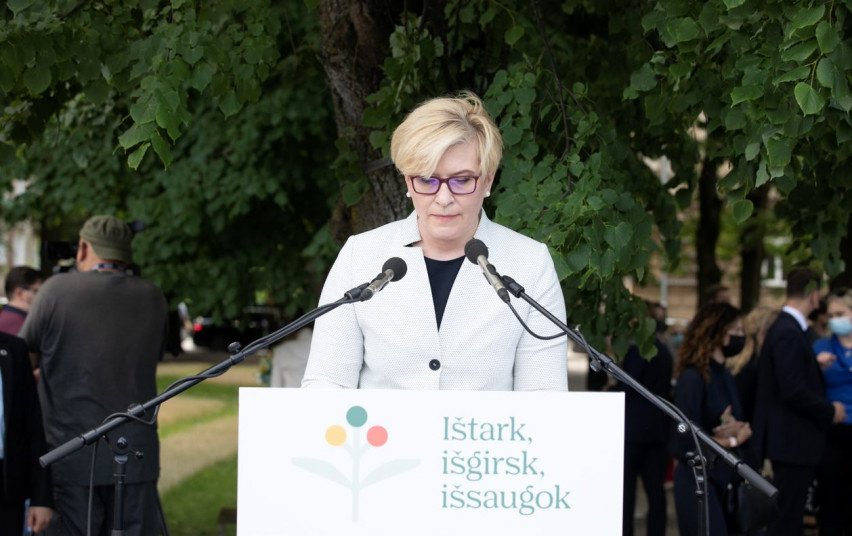
Prime Minister Ingrida Šimonytė has taken part in events to commemorate the Day of Mourning and Hope and the Day of Occupation and Genocide. To mark the occasions, a solemn ceremony has been held in Lukiškės Square.
‘It is highly symbolic that on 14 June, we link up, at first glance, two very different words: ‘mourning’ and ‘hope’. Occupation, deportations, and war have broken fates of many people, have shattered dreams, and have torn apart families. That means the loss of one’s state and aching homelessness. We can only dream of how we would have lived today, what Lithuania would have been like, if it had not been for external aggression that had trampled down rights, destroyed numerous lives, and caused so much pain,’ said the Prime Minister.
However, according to the Head of Government, hope never fades, even in mourning; it is a reminder that even under the most tragic circumstances, in the face of brute force, exiled to the land of permafrost, having been carried in livestock wagons for weeks, despised and killed, our forefathers did not break down, did not disappear, and did not betray themselves. They managed to survive under the most difficult conditions, to recover, to return to the Homeland, to fight for freedom, to create and work patiently, and to raise children, passing on to them the love and customs of the Homeland, so that sparks were fostered to reignite the fire of freedom during the Revival.
‘Commemorations like this see fewer and fewer direct witnesses to past tragedies. Today, there are a number of people in the square who have been born in Independent Lithuania already, for whom the gruelling occupation is only the story of their parents and grandparents. It is very important that it be told, so that our memory is alive. For, as we sing in our anthem, we draw strength from the past. Trials not only disturb, but also reinforce and teach compassion. Today, we can stand with the Ukrainian and Belarusian brothers primarily because we ourselves have a history that encourages the appreciation of freedom,’ said the Prime Minister.
It is important to speak about the trials of the past because we must not allow them to happen again. Occupation, deportations – they are materialisation of hatred. It usually accumulates little by little, while forgetting to listen to each other and to allow each other to be, and without realising that rights without duties and freedom without responsibility turn into mere claims and futile expectations.
‘Today, we feel tension at the Lithuanian borders, and we hear threats again. We need to be united, courageous, and wise. But it is no less important to fight not only external aggression, but also the sediments of anger inside us. The Day of Mourning and Hope and the Day of Occupation and Genocide give us an excellent opportunity to feel once again a sense of unity that is, I believe, stronger than all our real or imagined differences,’ stressed Prime Minister Šimonytė.
The Head of Government has also taken part in a remembrance campaign ‘Ištark, išgirsk, išsaugok’ (‘Pronounce, Hear, Preserve’) next to the Monument for Deportees in Aukų Street.
Later on, the Prime Minister has paid tribute to the victims of the occupation, genocide and Soviet repressions at an event held at Naujoji Vilnia Railway Station Memorial.
‘Eighty years ago, livestock wagons full of Lithuanian people started their journey to Siberian exile from here. This is one of the most painful pages in our history. Indeed, we have the right to mourn. Occupation, deportations, and war have traumatised destinies of many people, and have torn families apart. It is the loss of one’s state and a stinging feeling of homelessness. It is the trauma that affects our collective memory to this day,’ said the Prime Minister.
According to the Prime Minister, memory connects different generations. It is highly important that free individuals do not run away from their history and from their past with all its achievements and losses. For memory teaches responsibility, it recalls the value of freedom and inspires courage, because the people who lived before us have been able to overcome much greater difficulties than we have today.
‘The Day of Mourning and Hope and the Day of Occupation and Genocide give us an excellent opportunity to feel once again a sense of unity that is, I believe, stronger than all our real or imagined differences. Our parents, grandparents, and ancestors have experienced many trials together. Let that help us not be divided for matters of much less significance,’ emphasised Šimonytė.
The full speech of Prime Minister Ingrida Šimonytė, delivered at a solemn ceremony of the Seimas in honour of the memory of the victims of the occupation, genocide and Soviet repressions, can be found here.