

Prime Minister visited medical research institutions in Japan, met with Hitachi CEO and delivered a lecture to students at Tokyo University of Foreign Studies
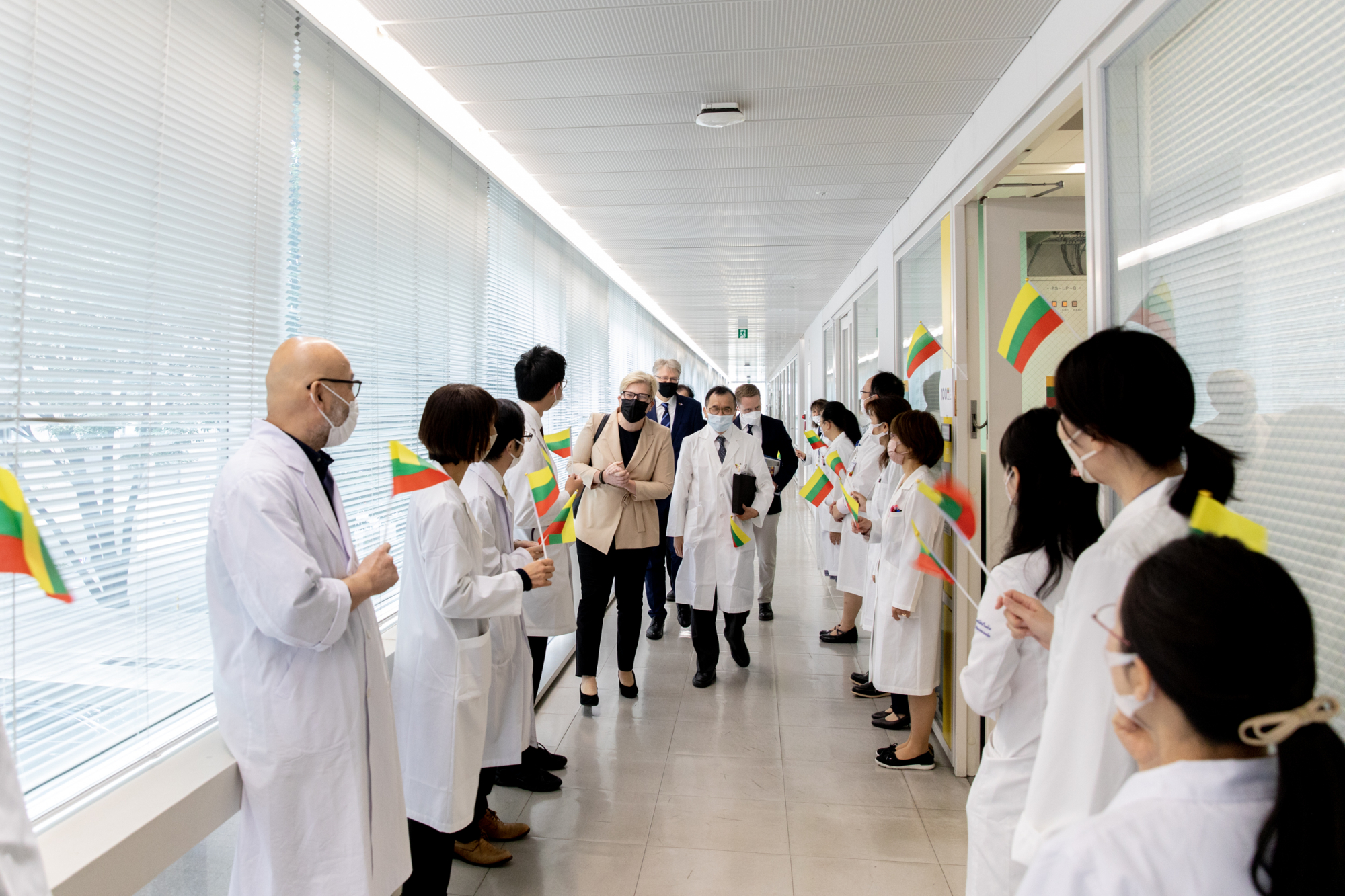
On Thursday, Prime Minister Ingrida Šimonytė, who is continuing her official visit to Japan, met with the President of the Japan Agency for Medical Research and Development (AMED), visited the Keio University School of Medicine, which is conducting joint research with Lithuanian scientists, met with the CEO of Hitachi, and visited the Tokyo University of Foreign Studies, where she delivered a lecture to its students.
The meeting with Yoshinao Mishima, the President of AMED, focused on the bilateral scientific cooperation between Lithuania and Japan–the results of the joint activities as well as the future prospects are already evident.
“Lithuania's life sciences sector is already a success story, while it is still growing–and the growth rate is among the fastest in the European Union. The possibility to cooperate and develop projects together with Japan is an opportunity for us to work with world-leading experts, while at the same time we see the potential for mutual benefit in this area, both in terms of manufacturing and research,” said Prime Minister Šimonytė.
Already in April 2020, the Ministry of Health of Lithuania and AMED signed a letter of intent on the implementation of joint research projects, and Japan has become one of Lithuania's main partners in the world in the fields of innovation and science.
Lithuanian scientists are carrying out joint projects with AMED and the Keio University School of Medicine–Prime Minister visited the latter on Thursday as well. One example of this partnership is joint cancer research.
At Keio University, Prime Minister Šimonytė said she felt proud of and grateful to Lithuanian and Japanese scientists and doctors, whose cooperation is helping to discover the causes of so far undetected diseases and to develop new treatment methods.
At the meeting with Hitachi CEO Toshiaki Higashihara, Prime Minister Šimonytė discussed the economic relations between Lithuania and Japan, which will be further facilitated by the strategic partnership established by the Heads of Government of both countries on Wednesday, as well as specific areas of cooperation between Lithuania and Hitachi, especially in the implementation of strategic infrastructure projects.
The Prime Minister noted that, as a member of the EU and NATO, Lithuania, offers safe and favourable conditions for investors.
During her visit to Tokyo University of Foreign Studies, the Prime Minister met with its President Kayoko Hayashi, gave a talk to the students and had a discussion with them. In fact, this University teaches the Lithuanian language, among others.
In her speech, the Prime Minister underlined the need for world’s democracies to invest in resilience to threats and to cooperate more closely with each other so as not to compromise national security and the way of life of their societies.
‘We cannot afford to repeat the mistakes of the past in dealing with autocrats. We cannot remain silent and indifferent, perhaps deeply concerned, but essentially inactive in the face of security threats, aggression or flagrant violations of international law. If the aggressor is appeased, the aggression pays off, and it will be repeated again and again,’ said the Lithuanian Head of Government, citing the cases of Russian military aggression in Sakartvelo in 2008, in Ukraine in 2014, and in February this year as examples.
It is important to stand up to Russia’s vast arsenal of disinformation and blackmail, including threats of nuclear weapons.
‘I have no doubts that Russia will never break the Ukrainian spirit. And I trust that Russia will never break the will of democratic countries to help Ukraine. If we give in to nuclear threats, we will open the floodgates to future nuclear blackmail by all dictators, from Russia to Iran to North Korea. If we lose in Ukraine, we lose everywhere. Our global security architecture will be shaped by the outcome of Russia’s war against Ukraine,’ said the Prime Minister.
Ingrida Šimonytė added that Japan’s voice is respected and appreciated in the world, and that its principled stance on Russia’s military aggression and its support for Ukraine is particularly important.