

The European Green Deal: ‘Lithuania is on track,’ says the Prime Minister
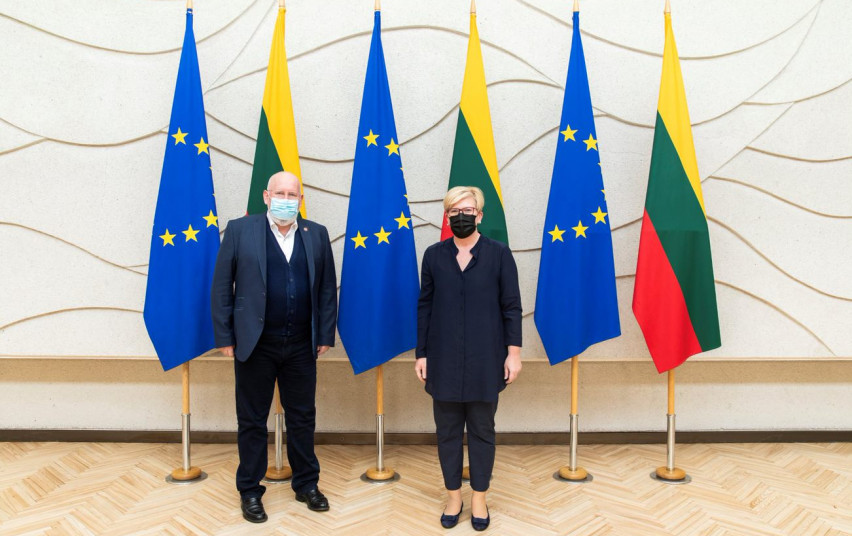
Prime Minister Ingrida Šimonytė has met with Executive Vice-President of the European Commission for the European Green Deal and Climate Action Frans Timmermans.
‘The Government has adopted the National Climate Change Agenda that is one of the pillars of green transformation; it has set national targets for 2030 and 2050, and climate neutrality scenarios for individual sectors. This and future decisions related to renewable energy, renewal of transport, and expansion of protected areas show that Lithuania and the EU Green Deal aim at similar objectives,’ said the Prime Minister.
Lithuania has cut CO2 emissions by 57 percent compared to 1990, which is among the best results in the EU. Negotiations at the European Union level on burden-sharing have to take into account EU member state characteristics and efforts to reduce emissions. The GDP per capita principle would reflect the capacity of countries to contribute to new commitments. However, the proposed principle of cost-effectiveness would lead to additional obligations for the member states with the biggest socio-economic challenges. Therefore, Lithuania proposes abandoning the latter principle.
According to the Prime Minister, Lithuania is ready to support extension of the Emissions Trading System to include aviation and maritime transport. However, as regards inclusion of the road transport and construction sectors, Lithuania believes that given differences among the lowest-income people in the EU, the EU is not prepared at this stage to apply uniform emission charges to transport and, especially, apartment buildings. Regarding greenhouse gas absorption, we have to play an active role in the forthcoming negotiations on quota allocations for EU member states.
Lithuania welcomes the future EU Forest Strategy that will contribute to the continuous implementation of sustainable forest management, yet a balance has to be found between the competences of the EU and those of member states in forestry sector. As Europe moves towards cleaner energy, it is important to ensure sustainable use of all forms of bioenergy in the long term.
Prime Minister Šimonytė has expressed Lithuania’s gratitude for the EU’s support while aiming to stop the operation of the unsafe Astravets NPP.
‘We welcome a Carbon Border Adjustment Mechanism. It is important that it be applied to electricity imports from third countries that do not meet the highest international environmental and nuclear safety standards. The interests of the EU as a whole will thereby be protected. We believe that the EU, its companies, and financial institutions should not contribute to the financing of ‘state’ projects of Belarus regime and should not issue guarantees to them,’ said the Head of Government.